
01 / Project Overview
Project Overview
Total storage capacity (this project)
Wheat silos
Wheat processing capacity
Wheat blending bin

02 / Challenges
Project Challenges
100,000 t storage must sustain 60,000 t/yr of continuous milling
The mill cannot stop for lack of wheat. Harvest arrives in a short window, so the silos must absorb concentrated intake and then release grain steadily to the flour lines — a reserve of over 10,000 t held at all times.
Ten 10,000 t silos and one blending bin must work as a single system
Large silos control volume and cost; the 800 t blending bin controls recipe and quality. Any weak link in conveying or scheduling between them turns blending into a production bottleneck.
Continental climate: 45°C summers, freezing winters and condensation risk
Central Asia’s continental climate swings from summer heat above 45°C to prolonged freezing winters[reference:0]. These extremes drive moisture migration, roof condensation, hot spots and insect activity inside the grain bulk[reference:1]. Sealing, insulation and aeration must be designed for this range from the start.
Contract farming brings many scattered batches that still need separation
Under the “enterprise + cooperative + farmer” model, raw grain arrives from multiple production areas with wide quality variation. The silos must support batch segregation and quality-based blending while feeding the cleaner and smart flour line without interruption.
03 / Solution
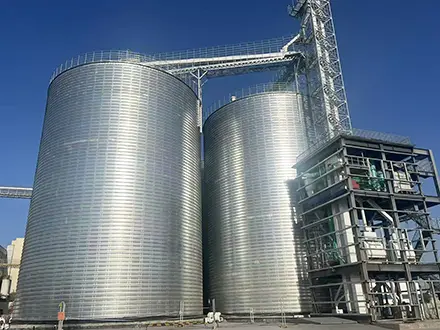
Solution: 10,000T × 10 Wheat Silos + 800 t Blending Bin
10,000T × 10 groups (main silos)
Handles concentrated harvest intake and long-term storage of the main wheat stream. Ten silos at 10,000 t each deliver 100,000 t of capacity — large enough to cut unit storage cost, few enough to keep level and batch management clear.
800 t blending bin (supporting)
Manages recipe-based blending and quick turnover. Small capacity and fast switching create a clear division of labor: the main silos control volume, the blending bin controls formula and quality.
Sealed steel silos engineered for continental temperature extremes
Sealed steel silos with moisture-proof and insect-proof design, insulation on the roof and upper wall rings, and aeration / temperature control tuned to in-silo conditions — reducing condensation, hot spots and insect activity across the full seasonal range[reference:2].
System equipment
-
Inlet and outlet conveying linking the automatic grain cleaner, main silos, blending bin and flour lines -
Aeration and temperature control adjusted to in-silo conditions to reduce condensation and localized heating -
Moisture-proof and insect-proof measures suited to the continental climate -
Level and storage-status monitoring to support batch segregation and blending scheduling -
Dust control at filling, discharge and transfer points
04 / Highlights
Technical Highlights: Why 10,000T × 10 Groups + a Blending Bin
10,000 t silos: fast harvest intake, clean production-season management
At 10,000 t per silo, this is a true 10,000-tonne-class configuration for a regional flour mill. Harvest intake is fast with minimal truck queuing; in production season, ten silos keep level and batch data far clearer than a large number of small bins.
Main silos + blending bin: storage scale and recipe flexibility in parallel
The ten 10,000 t silos solve “store more at lower cost”; the 800 t blending bin solves “blend accurately, switch quickly.” With many batches arriving under contract farming, main silos hold grain by batch while the blending bin turns over by recipe — blending stays off the bottleneck list.
Sealed storage + aeration, designed for Central Asia’s continental swing
Sealed steel silos with roof and upper-wall insulation reduce external heat transfer in summer above 45°C and limit freezing-driven moisture migration in winter[reference:3]. Aeration and temperature control adjust to in-silo conditions, protecting wheat quality through both extremes.
05 / Results
Project Results
-
✓
Created 100,000 t of wheat storage capacity (this project), supporting 60,000 t of annual wheat processing and a raw material reserve of over 10,000 t. -
✓
The 10,000T × 10 configuration lowers unit storage cost, and the moderate number of silos makes centralized management practical. -
✓
Main silos working with the 800 t blending bin deliver large-scale storage and recipe-based blending in parallel, supporting multi-batch raw material management under contract farming. -
✓
Sealed storage with insulation, moisture-proof, insect-proof and aeration measures suits the continental climate, reducing condensation, hot spots and pest risks across summer heat and winter freezing. -
✓
The storage system is integrated with the automatic grain cleaner and smart flour line, supporting the client’s contract farming model and green food production.
06 / Testimonial
Client Feedback
“With ten 10,000 t silos plus the 800 t blending bin, we can take in local contract wheat quickly during harvest, then blend by recipe and feed the mill steadily during production. The number of silos is moderate, so batch management is far clearer than before. Since commissioning, intake and line feeding have run smoothly — we have never had to stop the mill because storage or blending fell behind.”
Need a similar large-scale wheat silo + blending bin solution?
Tell us your grain type, target capacity, blending requirements, local climate and turnover rhythm. We can review the silo bodies, inlet/outlet conveying, aeration and temperature control, and level monitoring as one integrated solution.